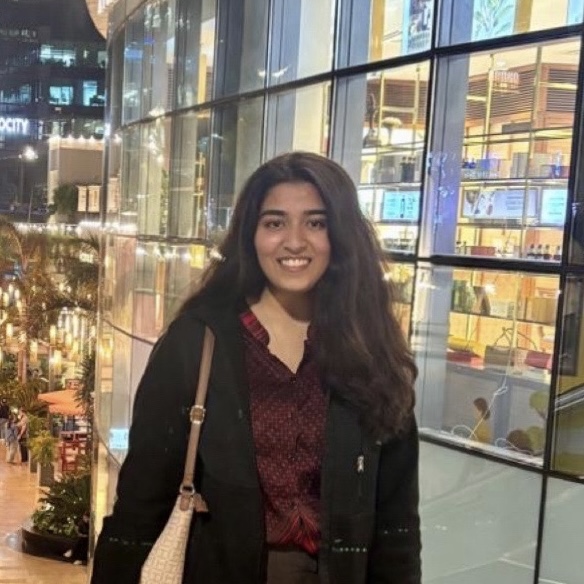
Introduction
Hey there, I'm Manya, a Computer Science graduate student at Arizona State University with a soft spot for systems that just work and a borderline obsession with making things more efficient. Whether it's streamlining a deployment, designing a clean dashboard, building an AI workflow, or figuring out why something broke at 2 AM, I genuinely enjoy solving problems and building things that make life easier for someone, somewhere.
These days you'll usually find me somewhere between backend systems and applied AI. I'm fascinated by reliable software, thoughtful system design, and AI that's actually useful instead of just flashy. I love understanding how different pieces fit together, and I'm always looking for cleaner, simpler ways to solve messy problems.
I learn best by building, breaking, and rebuilding. I ask a lot of questions (a lot), and I get excited by problems that need a thoughtful touch. If there's a chance to collaborate, experiment, or create something that makes an impact, count me in.
Outside of tech, I'm formally trained in guitar and Indian classical vocals, and every now and then I end up combining music with code just because it sounds like a fun idea.
Work
Software Engineer Intern, GenAI
Safexpress Pvt. Ltd., Gurugram, India
May 2026 - Aug 2026
-
Worked on SIA / BI Co-pilot, a Snowflake Cortex-powered GenAI assistant that answers natural-language business questions over the data of India's largest B2B logistics network reporting into the IT Digital & Analytics team.
-
Ran systematic QA against the live Cortex agent across its four core skill files (Orchestration, Geo-Disambiguation, Sales, Response), documenting a full prompt → failure → fix test log and rebuilding improved preprod_v2 / v3 / v4 skillsets.
-
Found and fixed high-impact correctness bugs: geo-disambiguation not triggering for names that exist at up to 6 geographic levels (e.g. Chandigarh, Delhi, Chennai); mandatory waybill filters being skipped (
CANCEL_RSN = 0 vs IS NULL) that silently pulled cancelled shipments into totals; and forecasts/predictions leaking into answers against policy.
-
Designed orchestration gates to refuse off-topic and web-search queries, enforce skill-invocation order (Geo → Domain → Response), and added an Output Contract so the agent stops exposing its internal reasoning and raw column names on complex multi-step questions.
-
Added fuzzy + phonetic matching (SOUNDEX, exact + normalization; evaluated Jaro-Winkler, Metaphone and edit-distance) to collapse duplicate customer and company names entered inconsistently across records.
-
Authored the Inbound/Outbound (Booking vs Delivery) disambiguation logic and a default-to-Region rule; standardized number formatting (L / Cr, 2 decimals) and Slack markdown (monospace code-block tables) for clean delivery inside Slack.
-
Reverse-engineered the legacy operations reporting stack tracing 30+ colour-coded TIBCO / Confluence reports (Pravega) back to their Snowflake source queries and documenting key tables and business purpose to feed the Copilot's semantic views.
-
Wrote SQL directly on Snowflake (CTEs, window functions,
QUALIFY, anti-joins, GROUP BY pivots) to validate agent answers against ground truth instead of trusting the bot.
Tools: Snowflake Cortex, SQL, Slack, Python (pandas, openpyxl), Semantic Views, Git
Student Researcher, Applied AI Systems
CIPS-AI Lab, Arizona State University
Feb 2026 - Present
-
Research intern in an Explainable Legal-AI group (PI: Prof. Hasan Davulcu) building ML pipelines and knowledge graphs over legal-enforcement and case-law corpora.
-
Set up and deployed an SEC-litigation scraper pipeline both locally (Python venv) and on ASU's Sol HPC supercomputer (mamba env, SLURM allocation, VPN/SSH), preparing reproducible compute for the team's experiments.
-
Ran a 16-section data-profiling report on a 902-case corpus, surfacing data-quality gaps (admission-status only 64.7% populated) and class imbalance (~2:1; 76% consent judgments) that directly shaped the classification target design.
-
Wrote an original TF-IDF classification experiment testing whether multi-word legal phrases improve accuracy comparing unigram / bigram / trigram features across Random Forest, Gradient Boosting and Logistic Regression with 5-fold cross-validation (F1-macro) — validating that bigram/trigram features let the model read phrases like “consent judgment” as single semantic units.
-
Built Python ETL to clean and structure unstructured legal documents for downstream ML, with structured logging for reproducibility across 20+ evaluation runs.
-
Prototyped Neo4j knowledge graphs linking cases, firms and statutes to support Cypher querying and retrieval-augmented workflows.
-
Currently extracting citations from 7,500 filtered Indian land-dispute cases (Indian Kanoon) to build a citation graph for Louvain community detection, as the project pivoted to Indian case law.
Tools: Python (scikit-learn, pandas, TF-IDF), Neo4j, ASU Sol HPC / SLURM, Cypher, Git
Software Engineering Intern, DevOps & Platform Systems
National Institute of Urban Affairs, Govt. of India
Aug 2024 - May 2025
-
Built and maintained Jenkins CI/CD pipelines with build validation, configuration checks, and deployment gating across 12+ containerized services, improving release reliability by 30% and enabling fast, consistent delivery across environments.
-
Implemented a Prometheus and Grafana monitoring and telemetry stack, validating metrics pipelines, dashboard visibility, and service availability to enable proactive incident detection.
-
Reduced incident recovery time by 25% by tracing Linux logs, container states, SQL queries, and OAuth failures to isolate root causes and restore service within SLA.
-
Configured and deployed the UPYOG Finance Module (WildFly, PostgreSQL, Mono UI) on a local environment for the National Urban Digital Mission.
-
Notable projects: ICCC Smart Cities control-center portal (PHP, MySQL, XAMPP); UPYOG Quickstart deployment framework (Docker, Kubernetes, Jenkins, Prometheus, Grafana); AAINA analytics portal (PHP, Redis, MySQL).
Data Analytics Intern
Indian Urban Observatory, Ministry of Housing and Urban Affairs
Dec 2023 - Feb 2024
-
Built SQL-backed data pipelines and validation workflows to process noisy, heterogeneous datasets from multiple government sources.
-
Developed Tableau dashboards for urban-development KPIs and automated Python-based anomaly detection to flag inconsistencies across multi-source data feeds.
-
Worked with PAN-India datasets from the AMPLIFI 2.0 portal (literacy, transport, and ULB metrics) alongside EY analysts, structuring data to support policy-driven decision-making.
Summer Intern, Digital Workflows
Siemens Healthineers India
May 2023 - Jul 2023
-
Analyzed inspection activity across 100+ Siemens Healthineers staff using SafetyCulture, tracking year-over-year usage trends to identify engagement patterns.
-
Designed and executed a personalized outreach workflow, segmenting employees by activity thresholds and drafting tailored communications, tracked end-to-end in Excel.
Education
Arizona State University, Tempe
MS in Computer Science
August 2025 – Present
Manipal University Jaipur
Bachelors of Technology, Computer Science and Engineering, Core
August 2021 - July 2025
Sanskriti School, Chanakya Puri, New Delhi
April 2006 - May 2021
Relevant Researchwork:
Analysis and Mathematical Models of the Legal and Ethical Boundaries of AI
Feature Selection Using Gravitational Search Optimization on the Heart Disease Microarray Dataset
Contact
Project Work
AI product
Sage
Resume-to-role gap analysis
GPT-5.6TanStack StartTypeScriptTailwind
Click to flip ↻
Sage uses GPT-5.6 to reason about the real gap between your résumé and a target role — the recurring skill gaps you're missing and a direction to build, each verified against your résumé.
Open live demo →
← Back
Creative coding
Harmoneyes
Music ×Human–Computer Interaction
MediaPipeTone.jsCanvas
Click to flip ↻
A webcam instrument you play with your hands — hover over floating discs to sing layered harmony chords in real time, with a live Western ↔ Hindustani Sargam toggle.
Play live demo →
← Back
AI product concept
Setu
Specialized conversational AI
AI AgentsProduct Designcto.new
Click to flip ↻
A “bridge” to specialized support AI — seven distinct personas, each with its own focus, instead of one generic assistant. Product & persona design by me.
Open live demo →
← Back
Arizona State University
HireMate
Explainable job-matching
PythonNeo4jLangChainRAG
Click to flip ↻
An explainable job-matching assistant combining résumé parsing, RAG retrieval and a knowledge graph, with a human-in-the-loop feedback chatbot.
View on GitHub →
← Back
Capstone · NUDM
Portal Quickstart
Containerized e-governance
DockerKubernetesJenkins
Click to flip ↻
A reusable, containerized Quickstart that stands up the UPYOG e-governance platform for Urban Local Bodies across India — a repeatable deployment pipeline.
View live platform →
← Back
Housing & Urban Affairs
Smart Cities Dashboards
Urban analytics, 100+ cities
TableauSQLExcel
Click to flip ↻
Interactive Tableau dashboards visualizing urban-development metrics — education, infrastructure, governance and sustainability — across 100+ Indian cities.
View dashboards →
← Back
Music
Music has been a long-term discipline for me, not a side hobby. I’ve trained across Indian classical foundations
(ragas and melodic structure) and Western notation-based guitar curriculum, and I’ve performed in band and
ensemble settings as both a vocalist and guitarist.
Where music meets code
This is where my two worlds meet. I built Harmoneyes — a browser instrument you play with your hands
over the webcam, no keyboard or mouse. It maps your finger position to notes and chord qualities and sings
them back as layered harmony in real time. Because I trained in both Hindustani classical and Western notation,
I built a live Sa Re Ga ↔ A B C toggle so the exact same instrument speaks to a
sargam-trained musician and a Western-notation musician at once — down to the komal / teevra swara mapping and
a tanpura drone mode.
Play Harmoneyes
Core Training
-
Trinity College London Guitar Curriculum (India): Completed the graded plectrum guitar path through
Grade 5 (practical + theory), which qualifies me to teach guitar; continued classical guitar studies
(including repertoire from Trinity grade books).
-
Music theory & reading: Sight reading, rhythm accuracy, tempo/dynamics/articulation awareness, key/scale
recognition, chord construction (triads), and notation fluency in treble and bass clef.
-
Indian classical foundation: Early training included ragas such as Yaman, Bhairav, Bhairavi, Bhupali,
Megh, and Malhar, shaping how I think about mood, phrasing, and structure.
Performance & Ensemble Work
-
Vocals: Singing since childhood (lead vocalist in multiple performances; frequent solo/duet work; harmony
support in ensemble settings).
-
Instruments: Electric guitar, acoustic guitar, classical guitar; bass guitar experience in undergraduate band settings.
-
Band environment: Comfortable rehearsing for performances, listening and locking timing with others, and adapting parts
to match ensemble balance and difficulty level.
Creation & Tech-Adjacent Music Work
-
Notation & originals: Written short original guitar pieces and notated them in standard staff notation,
training attention to clarity and musical structure.
-
Recording & sound: Experience working with electric guitar signal chains and amplifier settings
(tone shaping and gain control), and using GarageBand for basic multitrack recording and cleanup.
-
Why it matters to my CS work: Music taught me disciplined iteration—practice loops, feedback, and precision—
the same mindset I bring to debugging, systems work, and building reliable tools.
Current Focus
Currently focused on strengthening technique consistency, refining tone and timing in performance contexts,
and improving how musical ideas translate into clean recordings and repeatable practice plans.
Pensées